
Verified Kissimmee Directory Collections
Kissimmee city directory research begins with two positively identified titles, not a presumed yearly run. The 1887 gazetteer is digitized and explicitly covers Kissimmee. A dedicated 1921 Polk title is verified through National Park Service historic-district documentation, but researchers must locate a holding copy for its pages. State and local repositories add shelf checks, yearbooks, photos, and related records.
| Collection | Years | Where held | Access |
|---|---|---|---|
| Orange County Gazetteer and Business Directory, John R. Richards & Co. | 1887 | Orange County Library System; UCF STARS | Free digital scan |
| Polk's Kissimmee and Osceola County Directory, R. L. Polk & Co. | 1921 | Title verified in NPS documentation | Request pages from a holding library |
| Florida city directories | Statewide early 1900s to present | State Library, Tallahassee | On-site reference; request exact Kissimmee shelf inventory |
| Spence Research Center collections | Donations since 1949 | Osceola History | Appointment or $10 staff search |
| Central Florida digital collections | Mixed periods | UCF RICHES and Central Florida Memory | Free photos, documents, maps, directories, and related records |
| Kissimmee Sanborn maps | May 1889 verified | Library of Congress | Free public-domain images |
This coverage table is deliberately precise. No public catalog inspected supplied a full local run of printed directories, reverse directories, telephone books, or obituary indexes.
A useful request names the date and source type rather than asking for “all directories.” Ask whether the item is a residential directory, business gazetteer, telephone book, yearbook, or street-order volume. Those formats index people in different ways. Also ask whether the copy is complete, searchable, on microfilm, or limited to reference-room use. A clear answer prevents an isolated catalog title from being mistaken for a full Kissimmee city directory run.
Kissimmee in the 1887 Gazetteer
The 297-page Orange County Gazetteer and Business Directory was published by John R. Richards & Co. Its year is significant. Osceola County was created from Orange and Brevard in May 1887, so a Kissimmee listing can sit within an Orange County publication even as the new county government was taking shape. Treat the book as a business and place snapshot, not as proof of a household-by-household directory.
The UCF STARS volume record and scan is the strongest online entry point.
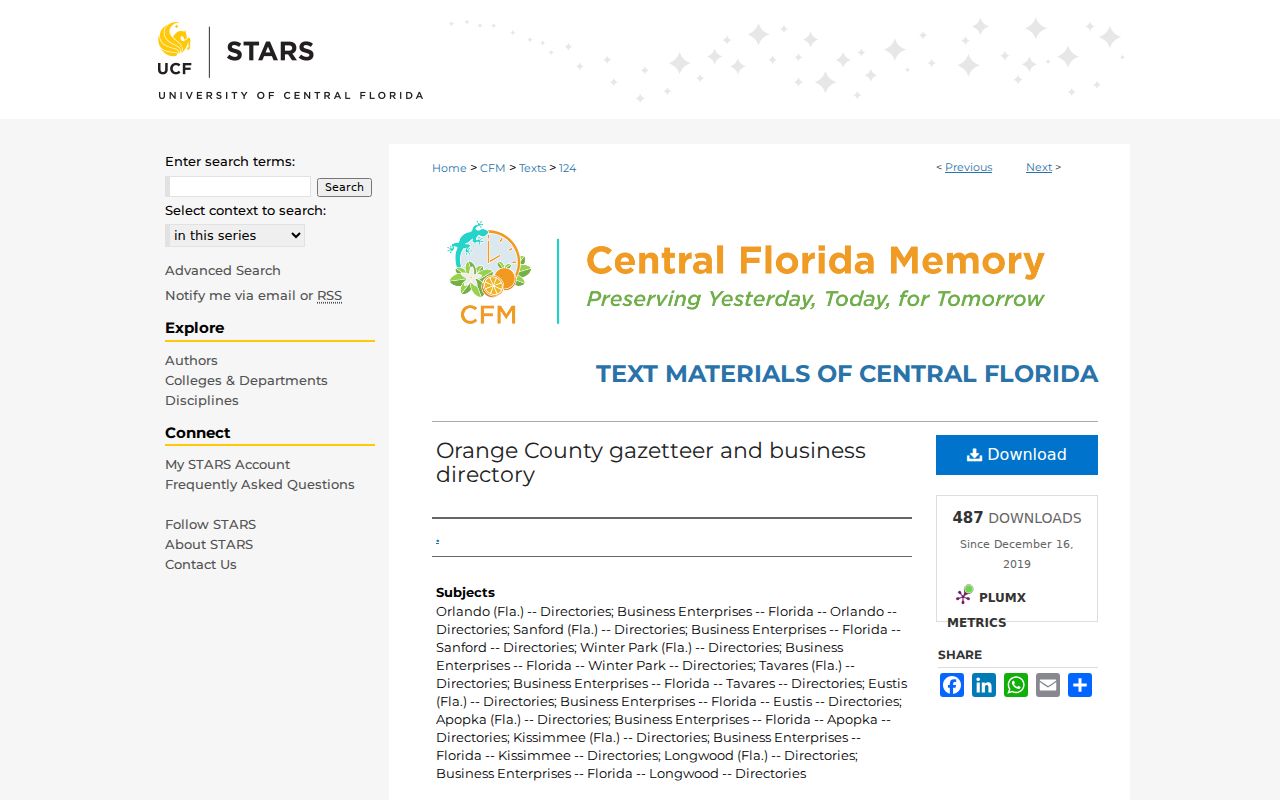
The repository confirms the title, publisher, date, length, and Kissimmee coverage. Since actual Kissimmee entry pages were not machine-readable during research, do not invent spouse, occupation, address, or owner marks from later directory conventions.
The 1921 Kissimmee Polk Directory
The verified 1921 title, Polk's Kissimmee and Osceola County Directory, is the clearest dedicated city and county directory target. R. L. Polk & Co. published it from Jacksonville. Its citation in National Park Service documentation establishes the work, but not a free online scan or a continuous set of nearby years.
Ask a reference librarian to locate the exact volume and copy the title page, abbreviation key, surname entry, and any street-order page that applies. A citation alone should never be expanded into claims about what one person's entry says. Pairing this city directory with the 1920 census can test names, household relationships, and address details across two independent sources.
Read a Kissimmee Directory Entry
Read the volume's own key before interpreting a line. City directory publishers changed abbreviations and field order. Later Polk books often used spouse names in parentheses and shortened words for widow, residence, or occupation, but those customs must be checked in the actual Kissimmee volume.
| Printed name | Copy spelling, initials, suffix, and order exactly as shown. |
|---|---|
| Trade or firm | Record only the work or business wording printed in that edition. |
| Address | Separate residence and business addresses if the key distinguishes them. |
| Family notation | Verify any spouse or widow convention against the volume key. |
| Property mark | Do not infer ownership unless the edition defines and displays a mark. |
The field list is an inspection guide, not a fabricated sample resident. Save an image of the page and key together so later readers can audit the interpretation.
- Criss-cross directory
- A directory section arranged by street or address rather than by surname.
- Householder index
- A name list centered on the person identified as the householder under that publisher's rules.
- Abbreviation key
- The page that defines shortened terms, symbols, and entry structure for that edition.
- Gazetteer
- A place and business reference that may be less complete as a resident roll than a dedicated city directory.
Check Kissimmee Directory Years First
The State Library keeps Florida city directories arranged by city and year at the R. A. Gray Building in Tallahassee. Call 850-245-6682 and ask for an exact Kissimmee inventory. State staff can confirm whether a year is on the shelf before a trip or copy request. The Osceola Library System is the local route for catalog searches, newspapers, yearbooks, licensed genealogy databases, and reference-only material.

The library gateway does not publish an exhaustive Kissimmee year list. Ask Hart Memorial Central Library staff to verify title and year, including materials not obvious in the public catalog.
That shelf check matters for reverse-directory claims. Research found no authoritative year range for local criss-cross volumes. A librarian's confirmation is the right answer when the catalog is silent.
Spence Adds Kissimmee Family Files
Osceola History's Spence Research Center holds local books, photographs, documents, limited family histories, and yearbooks. Access is by appointment. A remote staff search costs $10, providing a practical route when a Kissimmee city directory trail needs a surname file, yearbook, photo caption, telephone book, address reference, or newspaper clipping. Contact the center at 407-396-8644, extension 5, through its research-request service.
Make a narrow request. Give the person's name variants, the address, a date range, and the exact kind of item wanted. Ask staff to state the title and year of anything found. The center's own biographical work shows why this helps: local family history becomes more reliable when checked against the Kissimmee Valley Gazette, Kissimmee Gazette, regional newspapers, and society archives.
Osceola Library staff and Spence serve different roles. The library can check its catalog, local newspapers, licensed databases, and reference holdings. Spence can search donated files, photographs, and local-history material that may not have a full online description. Use both channels when the surname appears in a city directory but the family's next address or later date is unclear.
Kissimmee Records Across Changing Borders
Directory evidence sits inside a larger records timeline. County borders and repository changes affect where the next source may be found.
| Year | Kissimmee records event | Research effect |
|---|---|---|
| 1883 | Kissimmee incorporated in January | Municipal history begins before Osceola County |
| 1887 | Osceola formed from Orange and Brevard | Search predecessor counties for earlier people and land |
| 1889 | May Sanborn sheets mapped Kissimmee | Compare structures and street labels with directory evidence |
| 1890 | County courthouse occupancy began | County custody became more settled |
| 1917 | Okeechobee County took former Osceola territory | Population and land continuity may cross another boundary |
| 1939 | WPA survey compiled county records history | Florida Memory preserves early custody context |
Major J. H. Allen once offered his dwelling and an iron safe for the first county records. Temporary offices also occupied private spaces before the courthouse opened. This local story explains why an old reference may name an unexpected custodian. No authoritative source reported a courthouse fire or flood loss, so Osceola should not be labeled a burned county.
Trace Families Through Kissimmee Directories
A city directory can place a name between census years, but it is strongest when paired with other records. The goal is to preserve what each source actually says and explain any gap without guessing.
- Choose the verified directory nearest the target date. Search all known spellings, initials, compound surnames, and accented or unaccented forms.
- Copy the line exactly. Save the title page and abbreviation key with the entry.
- Check the preceding and following verified years. A missing name may reflect omission, publication gaps, death, relocation, or a changed street.
- Pair 1921 with the 1920 census. Later findings can be compared with the public 1930, 1940, and 1950 censuses under the federal 72-year rule.
- Test the address in deeds, probate, obituaries, newspapers, Sanborn maps, and the parcel roll. Search Orange or Brevard records when the event predates Osceola's creation.
If the research shifts to a current parcel or full named street, use the Kissimmee street directory. That page owns modern address records; the historical shelf stays here.
Beyond Kissimmee City Directories
Sanborn maps, local newspapers, yearbooks, funeral records, photos, and probate files can explain what a directory cannot. The Library of Congress has free May 1889 Kissimmee Sanborn sheets showing building footprints, uses, and street names. UCF's RICHES and Central Florida Memory add place-tagged images, voter registrations, funeral records, maps, diaries, letters, and postcards.
The Carey Hand Funeral Home records cover 1891 through 1955 as a regional fallback and may list the deceased, parents, burial place, and other details. Digitized Kissimmee Gazette issues can supply advertisements, social notes, address changes, and obituaries. None is a substitute for the directory itself. Together they can confirm that a name and place belong to the same person and period.
Note: Publish only years and entry fields verified in a catalog, volume, or librarian response; a gap in the shelf is not proof that nobody lived there.